
The Forgotten Bible in Manchu - Chengcheng Liu
The Forgotten Bible in Manchu: Two Editions, Two Voices, One Salvation
When we think of missionary efforts in China, the spotlight usually falls on Chinese translations of the Bible. But hidden in the margins of history is another story - one that revolves not around Mandarin, but Manchu, the once-powerful language of the Qing dynasty.
In the early 19th century, European missionaries and scholars believed that Manchu might serve as the lingua franca of all East Asia.[1] After all, it was the native tongue of the Manchus, the rulers of the Qing Empire from 1644 to 1912. To reach the Qing court - and, by extension, the vast empire it governed - the British Foreign Bible Society (BFBS) set its sights not only on translating, but also publishing the Bible in Manchu.
This endeavour produced not just one, but two different editions of the Gospel of Matthew: the first in 1822, and a revised version in 1835. Their differences reveal not only linguistic and cultural tensions but also the contested role of Manchu as a “dying” or “living” language in the eyes of Europeans. In 1821, the BFBS commissioned Stepan Vasiliyevich Lipovzoff (1770-1841), one of the leading Manchu scholars of his day, to translate the New Testament. The goal was ambitious: if the Qing elites could be converted in their own language, the entire empire might follow.[2] By 1822, Lipovzoff had translated the first Manchu scripture - the Gospel of Matthew, published in St. Petersburg by the BFBS. This was a milestone. Though the Jesuit Louis de Poirot (1734-1813) had translated parts of the Bible into Manchu decades earlier in Peking, his work never left manuscript form.
But the political climate of the time meant the rest of Lipovzoff’s translation remained unpublished until the 1830s. George Borrow (1803-1881), a young and determined British missionary, was sent to St. Petersburg in 1833 to oversee the project as editor. Borrow and Lipovzoff collaborated to publish the complete Manchu New Testament in 1835.
At first glance, the 1822 and 1835 editions of Matthew seem similar. Both follow Lipovzoff’s translation, and both attempt to make the scripture intelligible to a Manchu-speaking audience. But one stylistic shift stands out:
1822 edition:addresses God directly with pronounssi(“you”) andsini(“your”).
1835 edition:removes those pronouns and replaces them with the nounama(“father”).
Take the first verse of Lord’s Prayer as an example:
1822 (Manchu):
Abka de bisire musei ama, sini gebu enduringge okini, sini gurun enggelenjikini.
(Our Father in heaven, hallowed be your name, your kingdom come.)
1835 (Manchu):
Abka de bisire musei ama, ama i colo gingguleme tukiyekini, ama i gurun enggelenjikini.
(Our Father in heaven, hallowed be Father’s name, Father’s kingdom come.)
What looks like a small tweak here in italic actually carries profound theological weight.
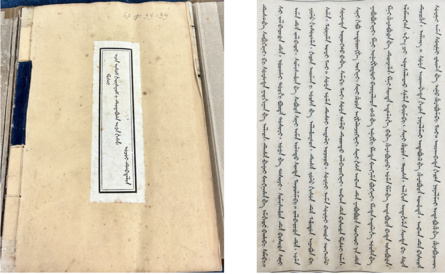
Gospel of St. Matthew, 1822, translated by Stepan Vaciliyevich Lipovzoff. The cover page and the Chapter 6 with the Lord’s Prayer in Manchu. Specimen from the BFBS collections, Cambridge University Library.
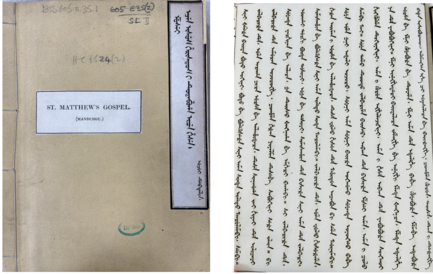
Gospel of St. Matthew, 1835, translated by Lipovzoff and George Borrow. The cover page and the Chapter 6 with the Lord’s Prayer in Manchu. Specimen from the BFBS collections, Cambridge University Library.
Borrow objected strongly to the removal of pronouns. In his view, Christianity emphasized intimacy between believers and God - a relationship not of distance, but of closeness. Usingsi (you)and sini (your), he argued, was like children addressing a father with reverence and love. Replacing these with the repeatedama (father)felt stiff and impersonal. Lipovzoff, however, had cultural and linguistic reasons for the change. In Manchu tradition, as in Chinese etiquette, second-person pronouns could be considered disrespectful when speaking to superiors or spiritual beings. Manchu Shamanist prayers avoidedsiandsinifor this very reason.[3] To use them for God would be, in Lipovzoff’s words, “the most uncouth and indecent way to speak to the Almighty - as if He were a servant or slave.”[4] There was also a grammatical problem. In Manchu,siandsinicould refer to both singular and plural subjects. For a faith that insisted on the singularity of God, this was potentially confusing. By contrast, repeatingamaremoved any ambiguity. Borrow eventually had to concede. As he later admitted, “I was compelled to acquiesce with his (Lipovzoff’s) dictum.”[5]
Beyond translation choices, these two editions also complicate the narrative that Manchu was already a dying language in the early 19th century.[6] Historians often portray Manchu as fading from daily use by this time, overshadowed by Mandarin. Yet the BFBS’s commitment to publishing a full New Testament in Manchu - even as late as 1835 - suggests otherwise. To European observers, Manchu was still the national language of the Qing Empire, a medium worthy of serious scholarly and religious work.
The story of the Manchu Bible isn’t just a footnote in missionary history. It’s a reminder of how languages - especially those tied to political power - carry enormous symbolic weight. For missionaries, Manchu was a gateway to the Qing elite; for scholars, it was a rich medium for history and literature; and for us modern readers, it challenges the idea that Manchu had already become irrelevant by the early 1800s. These two editions of Manchu Gospel of Matthew - 1822 and 1835 - tell us not only about different translation strategies, but also about broader questions of cultural respect and the politics of language in empires.
Today, Manchu survives as an endangered language, spoken by only a handful of people in northeast China. But its legacy, including the forgotten Bible translations of Louis de Poirot, Lipovzoff, and Borrow, shows us a time when Europeans still saw it as the key to an empire - and perhaps, in their eyes, even to salvation.
*This blog is adapted from a research paper currently under review with Central Asiatic Journal.
[1] “Considerations on the Language of Communication between the Chinese and European Governments”.Chinese Repository, volume. 13. 1844. pp. 290-300.
[2]Laamann, Peter, Lars. “The Christian Manchu Missions during the Qing period (1644-1911) – Perceptions and Political Implications”. In Early Encounters between East Asia and Europe: Telling Failures, edited by R. Hertel, M. Keevak, & T. Weststeijn. Routledge. 2017. pp. 101-122. p101.
[3]Erling, von Mende. “Problems in Translating the Bible into Manchu: Observing on Louis de Poirot’s Old Testament”. in Sowing the Word: The cultural impact of the British and Foreign Bible Society, 1804-2004, edited by Stephen Batalden, Kathleen Cann and John Dean. Sheffield Phoenix Press, 2004. p. 166.
[4] Jenkins, Herbert. The Life of George Borrow, Compiled from Unpublished Official Documents, his Works, Correspondence, etc. London, 1912, Chapter IX, November 1834-September 1835.
[5]Letters of George Borrow to the British and Foreign Bible Society on 20th, February, 1835.
[6] Kuzmin, Sergius L., Dmitriev, Sergey. “Conquest dynasties of China or foreign empires? The problem of relations between China, Yuan and Qing”. In International Journal of Central Asian Studies. 2015. p.76.
被遺忘的滿文聖經: 兩個版本,兩種聲音,一個救贖
當我們提到中國的傳教活動時,焦點通常集中在聖經的中文譯本上。然而,歷史的角落還隱藏著另一段故事,它並非源自漢語,而是以滿文為根,訴說著一段曾屬於滿清國語的聖經篇章。
在19世紀初,歐洲傳教士和學者相信滿文可能成為整個東亞的通用語言。[1] 畢竟,它是滿清王朝(1644-1912)這座龐大帝國的母語。為了接觸清廷,以及由其統治的帝國,英國聖經公會(BFBS)不僅著眼於翻譯滿文新約,還致力於將其完整出版。在此進程中,聖公會先後出版了兩個不同版本的《馬太福音》:1822年的首版,以及1835年的修訂版。二者的差異不僅揭示了語言與文化上的張力,也反映出在歐洲人眼中,滿文究竟處於「衰亡」還是「生機」的爭論。
1821年,聖公會委託當時著名的滿學家斯捷潘·瓦西里耶維奇·利波夫佐夫(Stepan Vasiliyevich Lipovzoff,1770-1841)翻譯新約。他認為,如果清朝的滿洲權貴能用母語接受基督教,那麼整個帝國或許都會隨之皈依。[2]1822年,利波夫佐夫完成了首部滿文聖經譯本《馬太福音》,由聖公會在聖彼得堡出版。這是一個里程碑。雖然耶穌會士賀清泰(Louis de Poirot, 1734-1813)早在18世紀末就在北京翻譯過部分聖經,但他的譯本始終停留在手稿階段,從未出版。
然而,由於當時的政治環境,利波夫佐夫的其他新約譯文一直未能出版,直到1833年。在這一年,英國派出年輕有為的傳教士喬治·保羅(George Borrow, 1803-1881)前往聖彼得堡,擔任編輯,負責推動出版工作。保羅與利波夫佐夫合作,於1835年終於出版了完整的滿文新約。
乍一看,1822年與1835年的《馬太福音》似乎相差無幾。兩者都遵循利波夫佐夫的譯文,但其中有一個顯著的文體轉變:
1822年版本:用第二人稱代詞si(「你」)和sini(「你的」)直接稱呼上帝。
1835年版本:刪除這些代詞,改用名詞ama(「父親」)。
以主禱文第一句為例:
1822年(滿文):
Abka de bisire musei ama, sini gebu enduringge okini, sini gurun enggelenjikini.
(我們在天上的父,願你的名被尊為聖,願你的國降臨。)
1835年(滿文):
Abka de bisire musei ama, ama i colo gingguleme tukiyekini, ama i gurun enggelenjikini.
(我們在天上的父,願父的名被尊為聖,願父的國降臨。)
如斜體字所示,看似細微的改動,卻承載了深刻的神學含義。
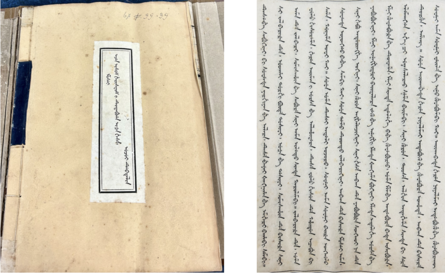
1822年版《馬太福音》封面和第六章主禱文。藏於劍橋大學圖書館英國聖經公會檔案館。
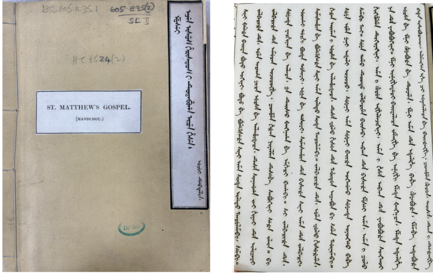
1835年版《馬太福音》封面和第六章主禱文。藏於劍橋大學圖書館英國聖經公會檔案館。
然而保羅卻強烈反對刪除代詞這件事。在他看來,基督教強調的是信徒與上帝之間的親密關係,不是疏遠,而是親近。用si(你)和sini(你的)稱呼,就像孩子以敬畏與愛意稱呼父親。而反覆以ama替代,則顯得生硬而缺乏感情。利波夫佐夫則出於文化與語言上的考慮,堅持更改。在滿文傳統中,如同漢語禮儀一樣,對尊者或神靈直接使用第二人稱代詞,常被視為不敬。這也正是滿人薩滿禱詞中刻意避免si與sini的原因。[3] 因此,在利波夫佐夫眼中,用第二人稱代詞稱呼上帝,就是「對全能者最粗俗和不體面的稱謂,彷彿祂是僕役或奴隸。」[4]此外,還有一個語法上的問題:滿語中的si和sini可以指代單數或複數。而基督信仰強調上帝的獨一性,這可能導致歧義。相比之下,重複使用ama則完全消除了這種模糊性。最終,保羅不得不讓步。正如他後來所承認的:「我被迫同意了他(利波夫佐夫)的乾綱獨斷。」[5]
除了翻譯取捨之外,這兩個版本也讓人重新思考:19世紀初的滿文真的是一種「衰亡中的語言」嗎?[6] 許多歷史學家常將滿文描繪為一個在這一時期已逐漸淡出日常使用,被漢語取代的語言。然而,聖公會在1835年仍然堅持出版整部滿文新約,恰恰說明在歐洲人眼中,滿文依然是清帝國的國語,依然是學術與宗教事業中值得運用的媒介。
滿文聖經的故事,並不僅僅是中國傳教史中的一個腳註。它時時提醒我們:語言,尤其是與政治權力緊密相連的語言,承載著巨大的象徵意義:對傳教士而言,滿文是通往清廷的門戶;對學者而言,它是研究歷史與文學的豐富資源;對今天的我們而言,它挑戰了「滿語在19世紀已無關緊要」的傳統觀點。
1822年與1835年的兩部滿文《馬太福音》不僅揭示了翻譯策略的差異,也展現了一個更廣闊的主題:文化尊重、語言政治與帝國背景下的交流。如今,滿文作為一個瀕危語種,僅在中國東北仍有極少數人使用。但它的遺產,包括賀清泰、利波夫佐夫與保羅的這些被遺忘的譯本,見證了一個事實:在19世紀前葉的歐洲人眼中,滿文依然是打開帝國的鑰匙;甚至,在他們的理解中,滿文是通向救贖的大門。
*本篇博客源自一篇當下由 Central Asiatic Journal 評審的專文。
[1] “Considerations on the Language of Communication between the Chinese and European Governments”.Chinese Repository, volume. 13. 1844. pp. 290-300.
[2]Laamann, Peter, Lars. “The Christian Manchu Missions during the Qing period (1644-1911) – Perceptions and Political Implications”. In Early Encounters between East Asia and Europe: Telling Failures, edited by R. Hertel, M. Keevak, & T. Weststeijn. Routledge. 2017. pp. 101-122. p101.
[3]Erling, von Mende. “Problems in Translating the Bible into Manchu: Observing on Louis de Poirot’s Old Testament”. in Sowing the Word: The cultural impact of the British and Foreign Bible Society, 1804-2004, edited by Stephen Batalden, Kathleen Cann and John Dean. Sheffield Phoenix Press, 2004. p. 166.
[4]Jenkins, Herbert. The Life of George Borrow, Compiled from Unpublished Official Documents, his Works, Correspondence, etc. London, 1912, Chapter IX, November 1834-September 1835.
[5]Letters of George Borrow to the British and Foreign Bible Society on 20th, February, 1835.
[6] Kuzmin, Sergius L., Dmitriev, Sergey. “Conquest dynasties of China or foreign empires? The problem of relations between China, Yuan and Qing”. In International Journal of Central Asian Studies. 2015. p.76.